
Welcome to your journey to China.
Perhaps you've already seen the dazzling night view of the Bund in Shanghai, the awe-inspiring array of the Terracotta Army in Xi'an, or the adorable pandas in Chengdu on social media—but now, setting foot on this land is easier than ever.
This guide was created just for that. From visa policies to route planning, from transportation to mobile payments, from internet access to cultural etiquette—we'll guide you step-by-step through all the preparations for your first trip to China.
I. Entry Preparation
1.1 Do I need a visa?
This is the most important step in all the preparations.
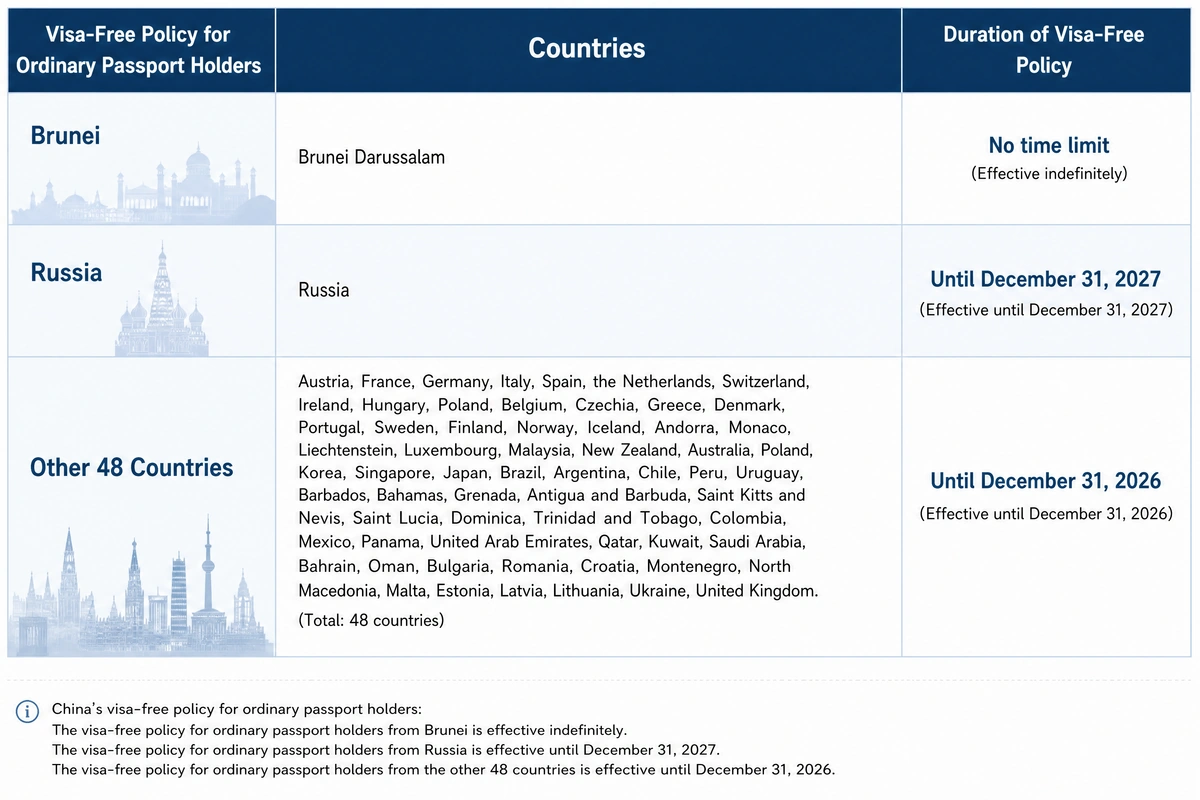
30-day unilateral visa-free entry
Holders of ordinary passports from the following 50 countries may enter China without a visa for business, tourism, visiting relatives and friends, exchanges and visits, or transit, provided their stay does not exceed 30 days:
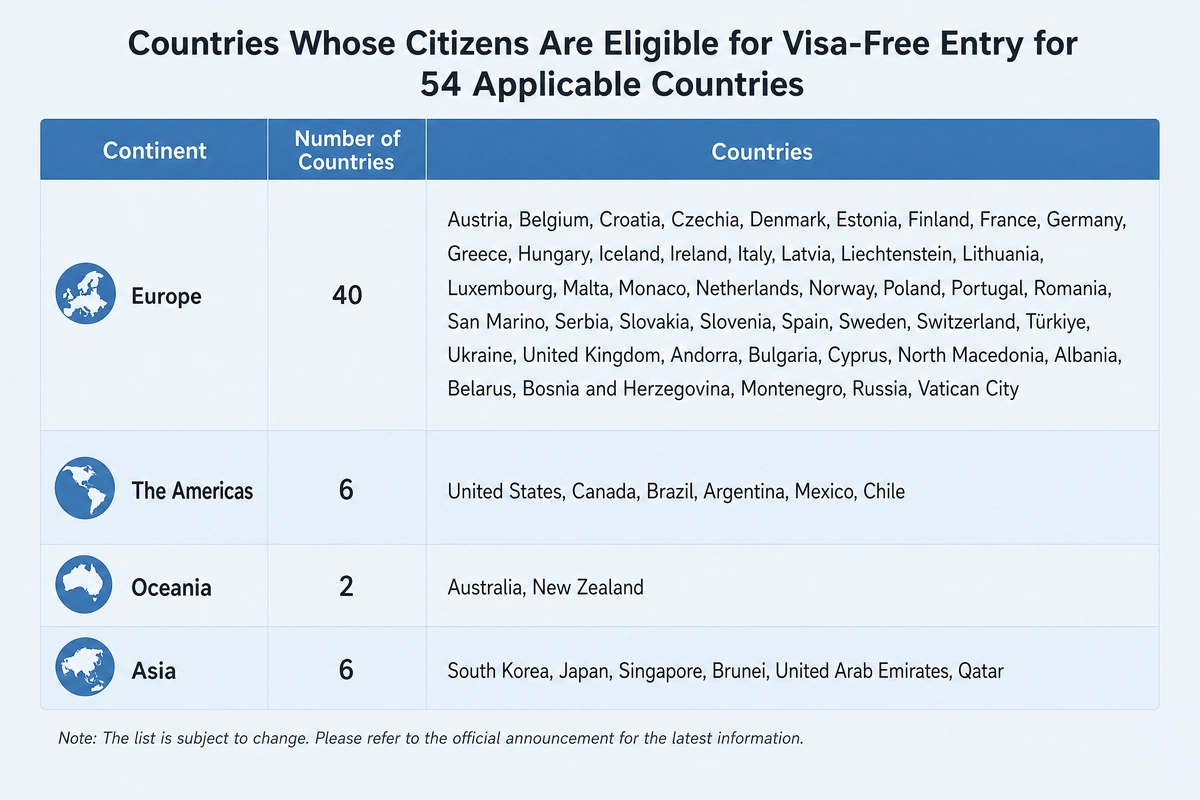
240-hour (10-day) visa-free transit
China has implemented a 240-hour visa-free transit policy for nationals of 54 countries. Travelers from these countries holding valid international travel documents and confirmed onward tickets to a third country or region may enter China visa-free through 60 designated ports of entry across 24 provinces, for a stay of up to 10 days. During their stay, they may engage in activities such as tourism, business, official visits, and visiting relatives.
24-hour visa-free transit
A 24-hour visa-free transit policy applies to travelers from all countries at all Chinese ports of entry open to the outside world. Foreign nationals holding valid international travel documents and confirmed onward tickets—traveling via international aircraft, vessels, or trains through China to a third country or region—are exempt from visa requirements provided they stay within the designated area of the port of entry for no more than 24 hours. Should they need to leave the designated area of the port, they must apply to the border inspection authorities at the port for a temporary entry permit.
30-day visa-free entry to Hainan
Nationals of 61 countries may enter Hainan visa-free for short-term purposes—such as tourism, business, visits, family reunions, medical treatment, exhibitions, and sports competitions (excluding employment or study)—provided their activities are confined to the administrative area of Hainan Province, they enter and exit through any of the province's ports open to the outside world, and their stay does not exceed 30 days.
Important Note: The duration of stay for visa-free entry is calculated starting from the day following the date of entry. If you plan to stay for more than 30 days, or if the purpose of your visit is work, study, or news reporting, you must obtain the appropriate visa from a Chinese embassy or consulate in advance.
1.2 What documents are required for visa-free entry?
Although visa-free entry means you do not need to apply for a visa in advance, border control authorities will still verify the purpose of your visit upon arrival. It is recommended that you carry the following documents with you for inspection:
Valid ordinary passport: validity must cover the duration of travel in China
Return flight itinerary
Hotel booking confirmation
Letter of invitation (if applicable)
You can fill out the application form online via the Chinese Visa Application Service Center(https://www.visaforchina.cn/MEL4_EN/), schedule an appointment to visit the center in your country of residence to submit hard-copy documents, provide biometric data (fingerprints), and pay the fees.
1.3 Initial Entry Procedure
Travelers visiting China for the first time are generally required to use the manual processing lanes for entry formalities, which include the collection of fingerprints and photographs. Please allow sufficient time for the entry process.
Pre-departure checklist:
□ Check if your nationality is on the visa-free list
□ Ensure your passport is valid for more than 6 months
□ Book round-trip flights and a hotel
□ Purchase travel insurance
□ Download necessary mobile apps
□ Prepare a small amount of RMB cash
II. Route Selection
China is vast, so it is impossible to see everything in a single visit. Here are some recommended itineraries designed to suit different trip durations and interests.
2.1 Classic First-Time Route (8–10 days): Beijing → Xi'an → Shanghai
This is the "Golden Triangle" route, most popular among first-time visitors.
Beijing (3–4 days): Forbidden City, Great Wall (Mutianyu or Badaling), Temple of Heaven, Summer Palace
Xi'an (2 days): Terracotta Warriors, Ancient City Wall, Muslim Quarter
Shanghai (3–4 days): The Bund, Lujiazui skyline, Yu Garden, Wukang Road
High-speed train travel between cities: Beijing to Xi'an takes approximately 4.5 hours; Xi'an to Shanghai takes approximately 6 hours.
If you are short on time, you can also choose to visit just one of the cities.
Recommended Itinerary:
China 10-Day Private Tour Beijing Xian Guilin Shanghai
China 16-Day Private Tour Great Wall Pandas Avatar Mountains
2.2 If you have more time (12–14 days)
Building on the aforementioned route, the following can be added:
Chengdu (2–3 days): Research Base of Giant Panda Breeding, Dujiangyan
Guilin/Yangshuo (2–3 days): Li River cruise, karst landscapes
Hangzhou (2 days): West Lake, classical gardens
Recommended Itinerary:
Lijiang Snow Mountain Tiger Leaping Gorge 2-Day Private Tour
Zhangjiajie 3-Day Private Tour Wulingyuan and Glass Bridge
2.3 Customization based on interests
For nature enthusiasts: Zhangjiajie National Forest Park (filming location for Avatar), Yunnan (Kunming–Dali–Lijiang), Tibet (pilgrimage, ritual circumambulation), etc.
For history and culture enthusiasts: Nanjing, Luoyang, Dunhuang, etc.
For food lovers: Chengdu, Chongqing, Guangzhou, etc.
Please contact us if you would like to customize your own itinerary; we can design a personalized route based on your needs.
III. Transportation
3.1 Intercity Transport: High-Speed Rail vs. Air Travel
High-speed rail is the preferred mode of travel in China.
Selection Recommendations:
100–1,500 km: High-speed rail is the top choice
Over 800 km with no direct high-speed rail: Consider flying
Remote western regions or tight schedules: Flying
3.2 How to Purchase Train Tickets
Option 1: 12306 (Official China Railway App)
With a wider availability of tickets, you can choose the English interface to make your purchase.
Passport verification may take 1–24 hours.
Supports international credit cards (Visa/Mastercard).
Option 2: Trip.com (Highly recommended)
You can choose from multiple language interfaces.
Supports international credit cards (Visa/Mastercard)
Download the app and register to purchase tickets
Enter your passport number—your passport number serves as your ticket; no need to print anything
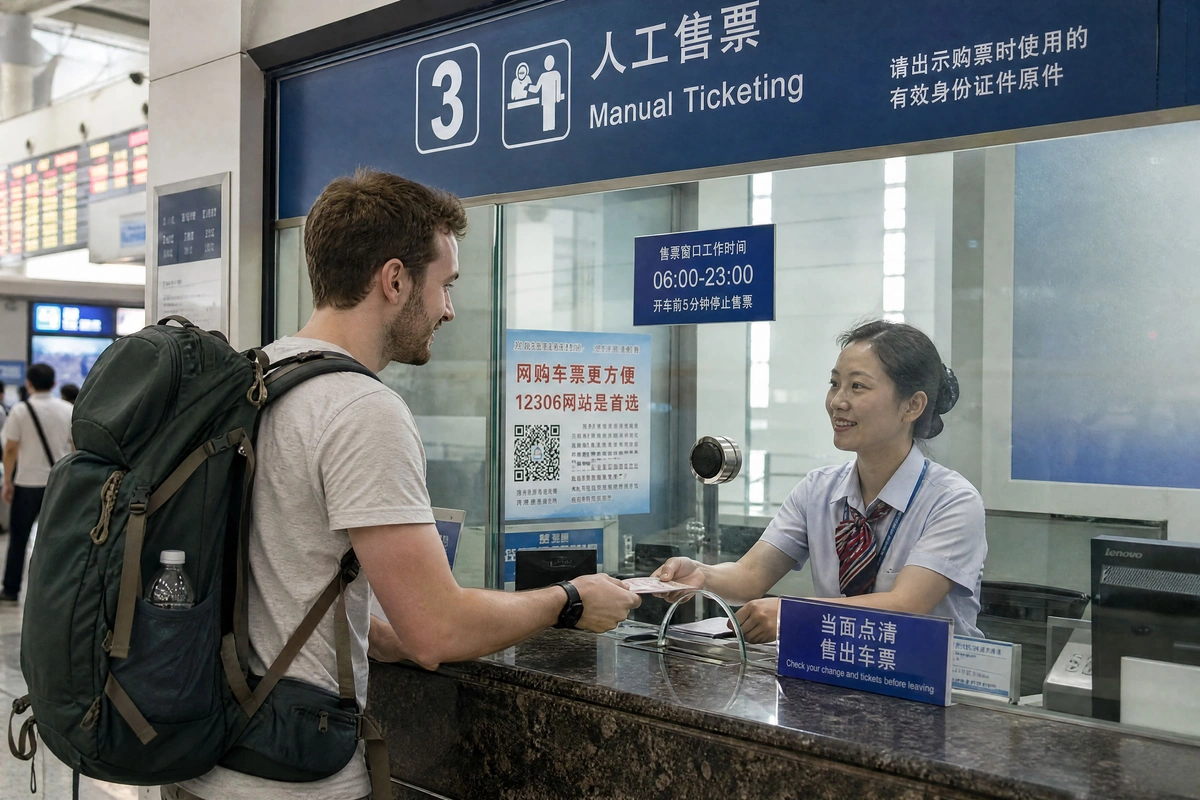
Option 3: Purchase tickets at the station counter.
Expect queues—queues can be long, and staff may not communicate in English.
3.3 Local Transportation
Subway: Subway networks in major Chinese cities are extensive, affordable, and punctual. You can enter stations by scanning a QR code via Alipay or WeChat.
Ride-hailing (DiDi): DiDi is the Chinese equivalent of Uber. You book rides through the app; pricing is transparent, so there is no need to negotiate the fare with the driver. Uber does not operate in mainland China.
Taxis: Taxis are readily available, but most drivers do not speak English or recognize addresses written in English. It is recommended to have the address ready in Chinese or use a map app to provide directions.
3.4 List of Transportation Apps (Download before departure)
Trip.com: Booking train tickets, flights, and hotels
DiDi: Ride-hailing
Amap (Gaode Maps): Chinese navigation (more accurate than Google Maps in China)
IV. Payment
4.1 Mobile Payment: The Dominant Payment Method in China
China is one of the countries with the highest adoption rates of mobile payments globally. From high-end hotels to roadside breakfast stalls, almost everywhere accepts mobile payments. In many places, cash is no longer accepted, or merchants may refuse it citing a lack of small change.
1. Alipay / WeChat Pay
Alipay and WeChat Pay are the two most mainstream mobile payment platforms in China.Both apps now fully support the linking of overseas bank cards—you can register and use them without needing a Chinese bank account or a Chinese mobile number.
Steps for Registering and Linking a Card on Alipay:
Step 1: Download the app
Step 2: Register an account
Step 3: Complete real-name verification:Tap "Me" in the bottom right corner → "Settings" → "Account & Security" → "Identity Information"
Step 4: Link an overseas bank card:After real-name verification is approved, tap "Me" → "Bank Cards" → "Add Bank Card".
For the detailed registration process, please see: Alipay
Steps for Registering and Linking a Card to WeChat Pay:
Step 1: Download the app.
Step 2: Register an account.
Step 3: Access WeChat Pay and link a bank card: Tap "Me" (bottom right) → "Services" → "Wallet" → "Bank Cards" → "Add a Card."
Step 4: Complete real-name verification: During the bank card linking process, the system will prompt you to complete real-name verification. You will need to upload a photo of your passport's information page and complete facial recognition. Once approved, you can use the service normally.
For the detailed registration process, please see: WeChat
2. Physical bank cards
UnionPay cards can be used at almost all POS terminals
Visa/Mastercard are accepted only at large merchants, hotels, and airports
Can serve as a backup payment method
V. Network Connection
In mainland China, overseas platforms such as Google, Facebook, Instagram, YouTube, and WhatsApp are blocked. This means you cannot directly use Google Maps for navigation, check Gmail, or browse Instagram.
5.1 Solution 1: International Roaming eSIM (Recommended)
Purchasing an international roaming eSIM with "built-in VPN" functionality is currently the simplest and most reliable solution.
Why it is recommended:
Data is routed via an overseas gateway (typically through Hong Kong or Singapore), bypassing the Great Firewall.
Services such as Google Maps, Instagram, WhatsApp, and Gmail are fully accessible.
No need to purchase a separate VPN or perform complex configurations.
Purchase and activate online before departure; ready to use immediately upon arrival.
5.2 Solution 2: Local SIM Card + VPN
If you choose to purchase a local Chinese SIM card, you will need to install a VPN to access overseas websites.
VPN Recommendations:
Shadowrocket:A paid iOS proxy tool that can be used alongside other VPNs.
LetsVPN: Balanced value for money (95% success rate)
ExpressVPN: A paid, classic, and reputable VPN service.
There are also Surfshark, Astrill, FlowVPN, and others.
You must install and configure your VPN before departure—you may be unable to download the app or access VPN websites once you arrive in China.
VI. Culture and Etiquette
6.1 Basic Social Etiquette
Chopsticks: Never stick chopsticks vertically into a bowl of rice—this symbolizes offerings made to the deceased and is considered inauspicious.
Feet: Do not place your feet on an adjacent chair in public places—showing the soles of your shoes is considered disrespectful.
Tipping: Tipping is not customary in Chinese restaurants or taxis.
Photographing military installations, police or law enforcement personnel, and strategic facilities is strictly prohibited.
Smoking is prohibited in public places.
6.2 Temples and Religious Sites
When entering a Buddhist temple or Taoist monastery:
Dress modestly (avoid tank tops or short skirts).
Maintain a quiet demeanor.
Do not speak loudly or engage in boisterous laughter.
Photography is prohibited inside some temples.
Overall public security in China is good, and crime rates are low. However, simply observe proper etiquette and decline invitations from strangers.
VII. Recommended Booking Timeline
2–3 months before departure: Check visa requirements and book flights
1–2 months before departure: Book hotels, plan your itinerary, and reserve tickets for popular attractions
2–4 weeks before departure: Purchase an eSIM, download necessary apps, and exchange a small amount of RMB
1 week before departure: Confirm all bookings and print important documents (hotel confirmations, flight details, etc.)
1 day before departure: Check passport validity, fully charge your power bank, and verify that all apps are installed